
Aggregate
Continuous mobile handling for crushed stone, gravel and sand across quarries, plants and ready-mix sites.
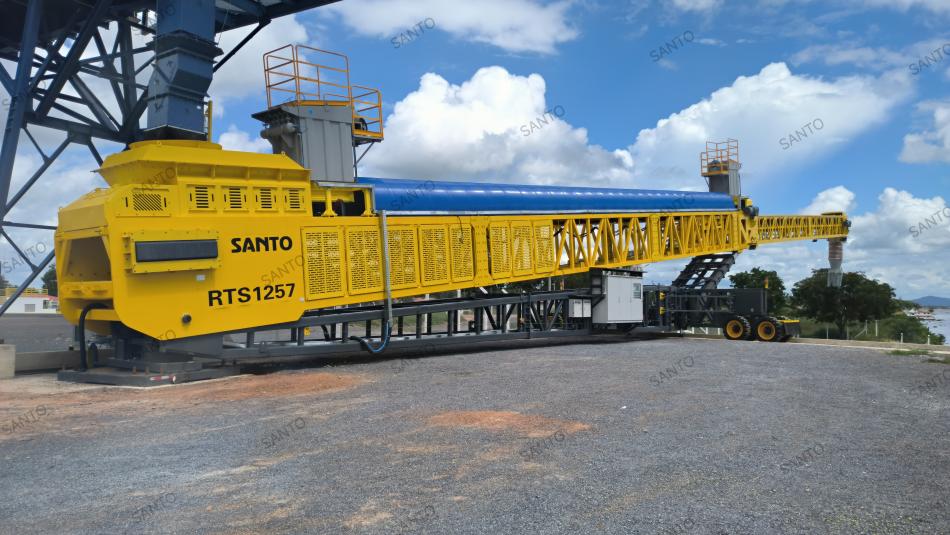
SANTO supplies mobile conveying, stacking and loading equipment engineered for aggregate — from receiving and stockpiling to reclaim and load-out. The notes below cover the properties that matter, the problems that typically appear on site and the machines we recommend.
Why Mobile Conveying Suits Aggregate
Aggregate is granular construction material — crushed stone, gravel and sand — ranging from 0–40 mm with bulk densities near 1.4–1.7 t/m³. The tracked radial stacker builds dense, well-graded stockpiles that protect particle shape and ease later loading.
- Radial stacking builds compact, high-density piles that lift yard utilization
- Low drop height preserves particle shape and gradation for sale value
- Continuous belt conveying cuts loader fuel and double-handling cost
- Mobile units relocate between grades and faces as the pit advances
- Dust suppression keeps fines on the belt and within site limits
Physical Properties and Handling Behaviour
The table below summarises the properties that decide belt specification, chute geometry and stacking method for this material. Values are typical ranges — actual figures vary with source and moisture content, so we test your sample before finalising a design.
| Property | Typical Value / Handling Impact |
|---|---|
| Bulk density | 1.4–1.7 t/m³ (loose, moisture-dependent) |
| Particle size | 0–40 mm for most concrete and asphalt grades |
| Abrasiveness | High — wears belts, idlers and impact beds |
| Angle of repose | 32–37° for screened, free-draining aggregate |
| Handling note | Minimize drop height to preserve particle shape and grading |
Handling Challenges with Aggregate — and How SANTO Solves Them
Aggregate is abrasive and free-flowing, so fixed drop points create segregation and the impact zone wears quickly. Without controlled stacking, fine and coarse fractions separate, harming concrete quality and sale grade.
SANTO tracked radial stackers and grasshopper conveyors deliver material at low, consistent drop height and build layered piles that stay homogeneous. Abrasion-resistant belts, impact beds and sealed idlers handle the wear while keeping the operation mobile between grades.
- Use impact beds and abrasion-resistant belt at the load zone
- Keep drop height low to avoid segregation and degradation
- Radial slew builds layered, homogeneous stockpiles
Recommended SANTO Equipment
For aggregate we most often supply the machines listed below. Each can be configured with the belt width, boom length and drive power your tonnage requires, and each is available on wheeled, tracked or crawler chassis.
- Tracked Radial Stacker — configured for aggregate duty
- Grasshopper Conveyor — configured for aggregate duty
- Tracked Stockpiler — configured for aggregate duty
- Feeder Track Stacker — configured for aggregate duty
Typical Stockpiling and Loading Setups
A well-planned aggregate yard keeps receiving, stacking and reclaiming on separate paths so trucks never queue behind a loader. In the most common layout, a mobile conveyor receives from the tipper or hopper and feeds a radial telescopic stacker that builds a layered stockpile, while a second conveyor reclaims to the loading point.
- Receiving: hopper or direct truck discharge into a mobile conveyor
- Stacking: radial or telescopic stacking to build layered, drainable stockpiles
- Reclaim: front-end loader feeding a mobile conveyor, or direct reclaim conveyor
- Load-out: conveyor to truck, wagon, barge or vessel hold
Frequently Asked Questions
How does mobile stacking protect aggregate gradation?
Low, consistent drop height and layered radial piles avoid the segregation and particle breakage that fixed chutes and loaders cause.
What belt specification suits abrasive aggregate?
Abrasion-resistant covers, impact beds and sealed idlers at the load zone handle the wear from 0–40 mm crushed stone.
Can one stacker serve multiple aggregate grades?
Yes. The radial stacker relocates between grades and faces, building separate, clean piles without fixed infrastructure.
Need the right machine for your site?
Send us your material, required capacity and site layout. SANTO engineers will size the equipment and return a configuration proposal within 12 hours — no obligation.