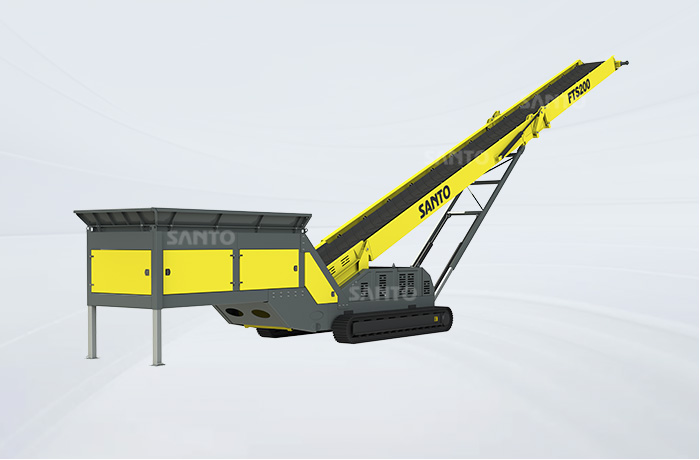
Feeder Track Stacker
Feeder track stacker with integrated hopper and belt feeder, 15-20 m belt and 100-1000 t/h.…
Learn more
Load and trim rail wagons cleanly with mobile conveyors that follow the train along the track.
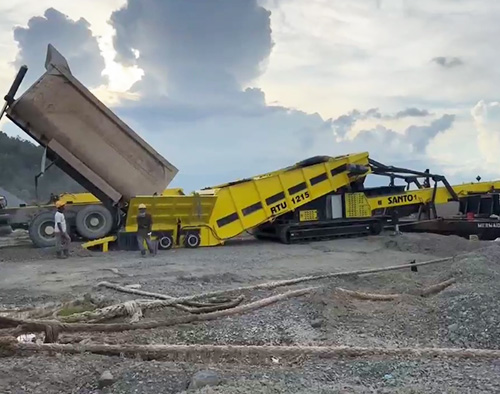
Rail yards benefit from mobile conveying because the loader travels with the train: a telescoping, slewing boom fills each wagon evenly and moves to the next, avoiding fixed trestles and long civil works.
Fixed rail loaders need a trestle, precise track alignment and long lead times, and they cannot serve a siding that changes use. Manual loading spills material and overloads wagons unevenly.
Mobile loading lets the equipment index wagon by wagon, controlling the stream so each is filled to the right level without spillage onto the track.
A feeder track stacker accepts truck or stockpile feed and discharges along the train, while the tracked radial stacker slews and luffs to place material precisely into each wagon.
For high-capacity terminals, a radial telescopic stockpiler feeds the line and a grasshopper conveyor bridges the stockpile to the rail, keeping the loading point mobile along the siding.
Material is conveyed to the loader at the head of the train; as each wagon fills, the machine indexes to the next, using telescopic reach and slewing to center the stream and trim the load. Low drop height limits dust along the track.
Because the loader is mobile, the same siding can handle different wagon sizes and the equipment moves to a second line, improving rail-yard flexibility.
Size capacity (up to 1500 t/h) and boom reach to your train length and wagon size; check track clearance and ground bearing for the mobile loader.
Plan dust control and even trim to avoid cleanup and re-weighing, and keep critical consumables on the spare-parts program so a stopped loader does not idle the train.
A feeder track stacker or tracked radial stacker travels along the siding, filling each wagon with a slewing, luffing and telescopic boom, then indexes to the next wagon.
Mobile loaders avoid long civil works and fixed alignment, serve changing sidings and wagon sizes, and can move to a second line — far more flexible than a trestle.
SANTO mobile conveying handles rail loading at up to about 1500 t/h with belt widths 500–1600 mm, sized to train length and wagon dimensions.
Feeder track stacker with integrated hopper and belt feeder, 15-20 m belt and 100-1000 t/h.…
Learn more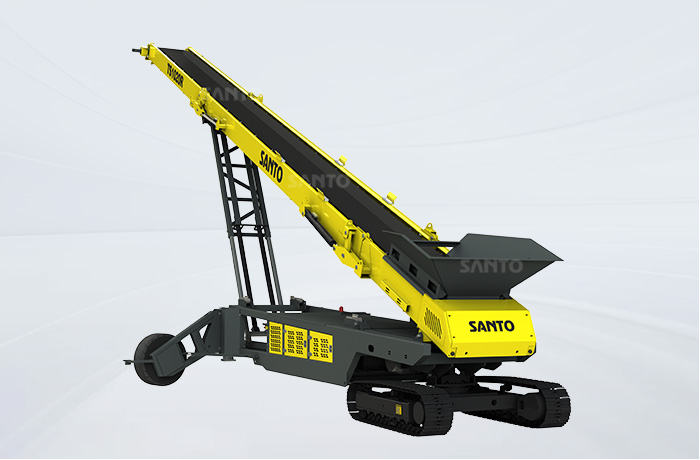
Tracked radial stacker with full 360° slew, 20-30 m belt and up to 1000 t/h. Builds large…
Learn more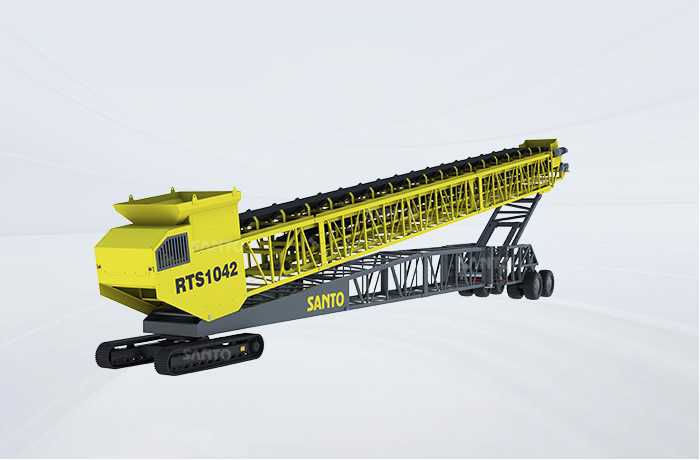
Radial telescopic stockpiler with extendable boom, 42 m reach, 14.5 m height and 700 t/h.…
Learn moreSANTO mobile conveyors and truck unloaders transfer bulk to and from railcars fast. Cut…
Learn moreSend us your material, required capacity and site layout. SANTO engineers will size the equipment and return a configuration proposal within 12 hours — no obligation.